New international food pyramid launched to counter Trump administration advice

A new dietary pyramid designed to rival Trump administration-approved advice has been released, with experts stating fibre and lean meat should be a priority.
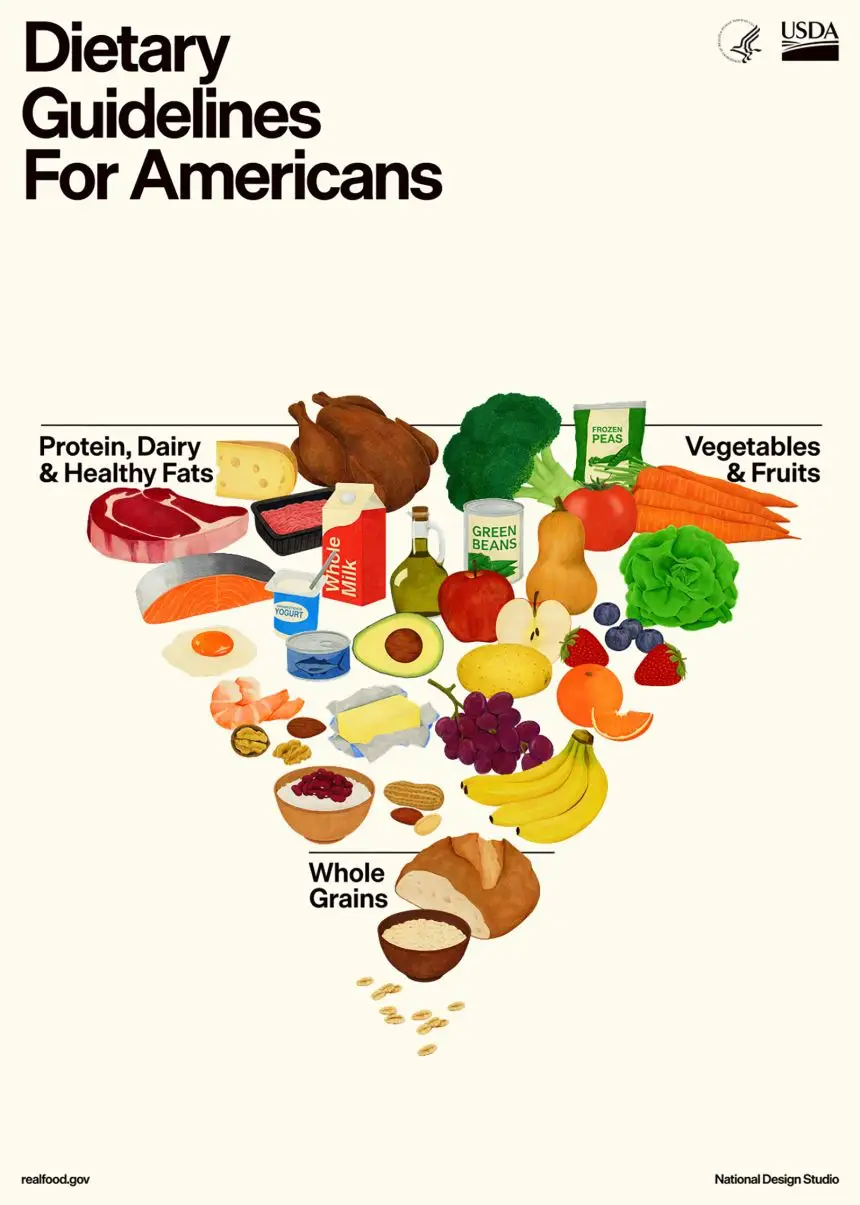
Earlier this year, Health and Human Services Secretary Robert F. Kennedy unveiled the updated 2025-2030 Dietary Guidelines for Americans. He also reintroduced and inverted the traditional food pyramid after a
US residents were advised to prioritise protein sources such as red meat as well as full-fat dairy products, including whole milk and cheese.
At the time, RFK Jr. stated the Republican administration wanted to ‘end the war on saturated fats’ while also tasking Americans to be ‘mindful’ about their alcohol consumption, rather than adhering to daily or weekly limits.
Advert
Less than a year later, an international group of nutrition scientists, led by a Brigham Young University (BYU) researcher and the International Carbohydrate Quality Consortium, has challenged the Trump administration’s food pyramid with their own.
On 23 September, the experts shared the International Food Guide Pyramid in Advances in Nutrition.
The information was published under the title ‘Toward International Dietary Guidance: A Food Guide Pyramid for Human and Planetary Health’.
Instead of fixing meals around meat, Karen Della Corte, a BYU Assistant Professor of Nutritional Science and a lead researcher behind the global food pyramid, wants the US to ‘start by thinking about the plant foods you want to emphasise’.
“What vegetables, whole or lower-GI grains, beans, or lentils could you include?,” she asked, explaining that plant-based items, fibre-rich favourites, and high-quality carbohydrates (GI) should be centralised.
Lean proteins like fish and poultry are ‘preferable to red and processed meats’, while canola or olive oil should be prioritised over butter and beef tallow, two products that have been popularised under President Donald Trump.

The pyramid also recommends keeping sugar intake below 10 percent of a person’s total calories, in line with former US guidance. Currently, the Trump administration’s pyramid suggests having no more than 10g per meal, as per The Independent.
Experts who worked on the new pyramid stressed that a diet not only has to work for our own health, but also for ‘the health of the planet’.
“Our science base has to be appropriately comprehensive to include that,” said co-author David Jenkins, a professor at the University of Toronto.
The statement comes as Stanford Woods Institute shared that livestock production accounts for 14 to 18 percent of global greenhouse gas emissions, including 32 percent of methane gas emissions worldwide.
Meanwhile, Trump—a long-time climate science and policy critic—previously described climate change at the United Nations General Assembly as ‘the greatest con job ever perpetrated on the world’.
"All of these predictions made by the United Nations and many others, often for bad reasons, were wrong. They were made by stupid people that have cost their countries fortunes and given those same countries no chance for success. If you don't get away from this green scam, your country is going to fail,” he said, as reported by PBS.
The 10-page US dietary guidelines do not take environmental impacts into account.
Since releasing the competing food pyramid, co-author Anette Buyken, a professor at Germany’s Paderborn University, has detailed next steps.
“We need food environments that make it easy to put the pyramid’s recommendations into practice.
“Knowing what is healthy and being motivated to eat healthily is not enough when these choices are difficult or expensive,” he added.
You can read the full study here.
 Ella Scott