
How to make your own oat milk and save a fortune

There are plenty of good reasons to stop drinking cow’s milk.
For one, there’s a decent chance you’re lactose intolerant. Interestingly, if you aren’t lactose intolerant, you’re part of a global minority! Around 65% of the global population has some form of lactose intolerance.
You might want to stop drinking cow’s milk for ethical reasons, too. The dairy industry is notoriously brutal for the cows at its centre.
To produce a milkable cow, dairy cows are artificially inseminated. If one carries her calf to term, she will spend around a day with it before it’s taken from her. This is how dairy cows are roped into producing milk; it’s naturally intended for their offspring.
Advert
The male calves are typically killed immediately or sold for veal, while the female calves become the next generation of milk producers.
Now, we’re not saying that to cast a moral judgement on anyone who drinks dairy milk, it’s simply the fact of the matter. What you do with that information is entirely up to you.
Anyway, if you decide for whatever reason to stop using cow’s milk, you’ve got a few options. One is to drop milk consumption of any sort, then the other is to opt for your preferred milk alterative.
Soy, almond, and oat milk are among the most common and, as their drinkers will know, they don’t come cheap.
However, as Emily Brown at our sister site UNILAD discovered, producing your own oat milk can be cheap and easy.
First up, you need a Milky Plant. It sounds vile, but it’s actually just a nifty little plant milk-producing device. They don’t come cheap, with a unit costing £299.95 in the UK at the time of writing.
A litre carton of Oatly oat milk costs £2.20 via Ocado. That makes the Milky Plant cost around the equivalent of 136 cartons of Oatly. If you go through two cartons of the stuff each week, then the Milky Plant will pay for itself in about 18 months.
Of course, you need the oats to make the milk, too. You could also use nuts if you prefer; the Milky Plant is pretty versatile.
Milky Plant estimates that, after the cost of buying oats, almonds, or cashews, you’re making significant savings on each litre you produce with the machine.
With oats, you’re looking at 42p per litre of oat milk compared with an average £2.10 for a litre from the shop. For almonds, it’s 60p against £2.30, and for cashews it’s 80p against £2.50.
That doesn’t factor in the cost of the machine, of course, but you can see how much cheaper it is to use a Milky Plant or something similar over the long term.
For Emily, the process was a breeze too.
“For my first attempt with the machine, I kept things simple - just oats and water,” she said.
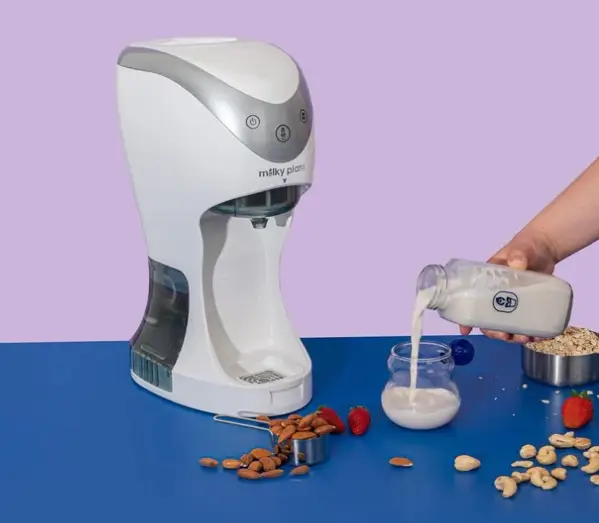
“This is oat milk in its purest form, and if you're just looking for something to moisten (sorry) your Cheerio's, then this will do the job, but it's not the most flavoursome of substances.
“If you're after something a bit sweeter or thicker, you will need to make a couple of adjustments to make the milk to your liking. You could opt for hazelnuts or almonds instead of the blander oat, or add a sweetener like golden syrup or vanilla extract once the milk has been deposited into the reusable Milky Plant bottle.
“It might take some time to get the formula just to your liking, but once you've cracked the ingredients, the milk is yours for the making.”
If you’ve made the switch to non-dairy milks, this could be a very sound investment indeed.
 Rachael Davis