Warning on ‘Japanese cheesecake’ trend as it goes viral

If your social feeds have recently been taken over by tubs of yoghurt being ceremoniously topped with biscuits and shoved into the fridge, you’re not alone.
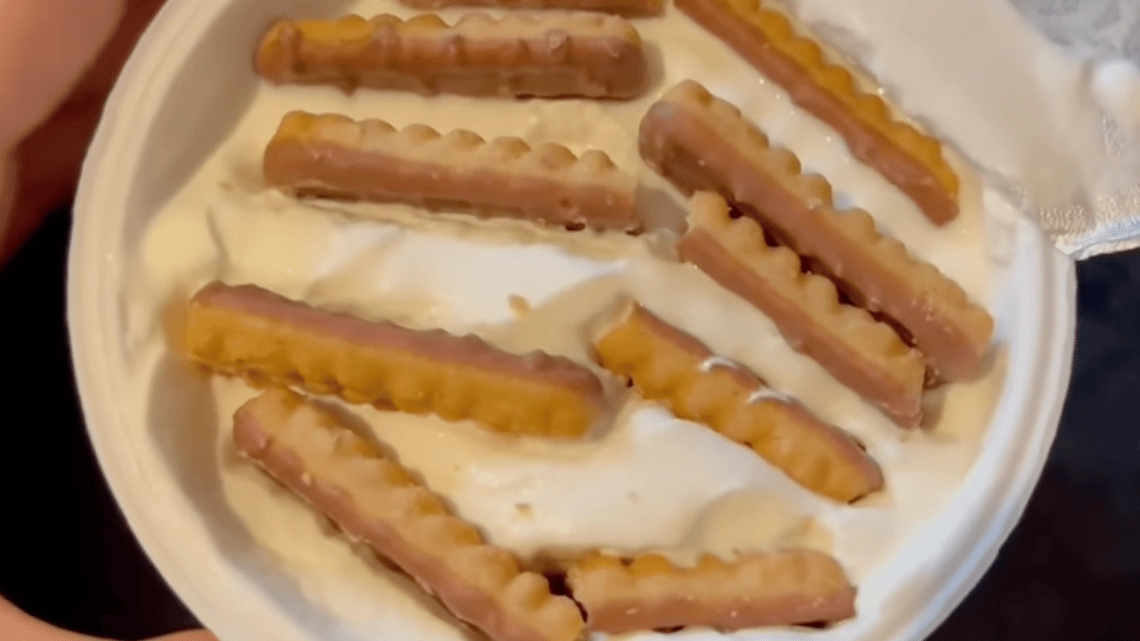
The so-called ‘Japanese cheesecake’ trend has quietly worked its way from niche TikTok hack to full-blown internet obsession, promising cheesecake vibes with almost no effort at all - and supposedly a big protein boost to boot.
At first glance, it’s easy to see the appeal. No baking. No water baths. No worrying about cracks or sunken centres. Just Greek yoghurt, a handful of Lotus Biscoff biscuits, and a bit of patience while the fridge does the heavy lifting.
It's also hugely customisable, meaning you don't have to stick with Biscoff biscuits or even necessarily Greek yoghurt - although the texture of the latter is what helps here: after 24 hours, creators reveal a thickened, creamy dessert that looks suspiciously indulgent for something that started life in a plastic tub.
Advert
Scroll through the comments, and you’ll find people marvelling at how rich it looks, others arguing over whether it can really be called cheesecake, and plenty admitting they’d happily demolish the whole thing with a spoon. That last part is where things start to get a little more complicated.
Great British Bake Off star and TV presetner Bryony May Williams is among the many to have tried it out for themselves - and been left impressed:
The trend has been praised by some nutritionists for being higher in protein and lower in calories than a traditional cheesecake made with cream cheese, sugar, and butter. Using zero percent Greek yoghurt or quark can significantly reduce fat content while still delivering a dessert-like texture. On paper, it looks like a smart swap.
But buried beneath the viral glow-up is a detail many viewers seem to be missing entirely: portion size.
Talking to Newsweek, registered dietitian Kristy Thomas has warned that the way the dessert is presented online can be misleading, particularly when it comes to how much people think they should be eating in one sitting.
She said: “Small single-serve tubs (125–170g) are designed for one sitting, but with big tubs (500g–1kg), it's not appropriate to eat them all at once.
"A good portion is 150–250g, so eating a big tub all at once would be too many calories and sugars and would be bad for your digestion."
Despite that, many viral videos show creators slicing straight into large tubs without clarifying whether the dessert is being shared or eaten across multiple days.
Comment sections have been rife with mostly those kicking off at the fact that none of these desserts are actually cheesecake (or even Japanese) but a few actually noticing the health worries have cut through.
For instance, in response to one Japanese cheesecake video on TikTok — one where the creator even drizzled her massive tub for what looks like caramel sauce — a user commented: “This is roughly 1500 calories for the pot (685cal yoghurt, 570 cals for 15 biscuits plus the sauce) so it may taste lovely but saying its healthy is not true at all.”
Another video on Instagram saw the same sort of response, but in a more lighthearted tone, saying: “My issue is I would eat the whole thing in one sitting and now I’ve consumed 700 calories in biscoff.”
The biscuits themselves are indeed another sticking point. While they add flavour and help thicken the yoghurt, they’re also responsible for most of the added sugar in the recipe. Thomas has previously described them as ‘unnecessary added sugars and refined carbs,’ suggesting moderation or alternative options for those focused on health.
Even when a health and fitness influencer on Instagram posted his own take — using a 450g of zero percent fat Greek yogurt and only six and a half Biscoff biscuits (490 calories, 51g in carbs, 10g of fat, 49g of protein) — one commenter was quick to point out the hole in the nutrition breakdown by flagging the sugar content.
They said: “How much total sugar after adding the biscuits? ... Never mind I done the research. 8 pieces (the amount of biscuits people are using) is a total of 24 grams of sugar. No thanks.”
None of this means the trend is inherently bad. For cheesecake lovers looking for something lighter, it can absolutely have a place.
“I see this trend in a positive light since it is a high-protein dessert," Thomas said.
“Compared to cheesecakes, it is a lot easier to fit into most nutrition plans.”
She added: “Overall, these desserts are regarded as ‘mindful indulgences’ for cheesecake lovers as they are rich and creamy, yet cut down on the sugar and fat.
"The no-bake, mousse-like cheesecake has the easiest preparation, while the baked version is a light and airy soufflé, with slightly lower calories, high in protein content, and is more like a soufflé.”
Topics: Social Media, TikTok, Instagram
 Ben Williams